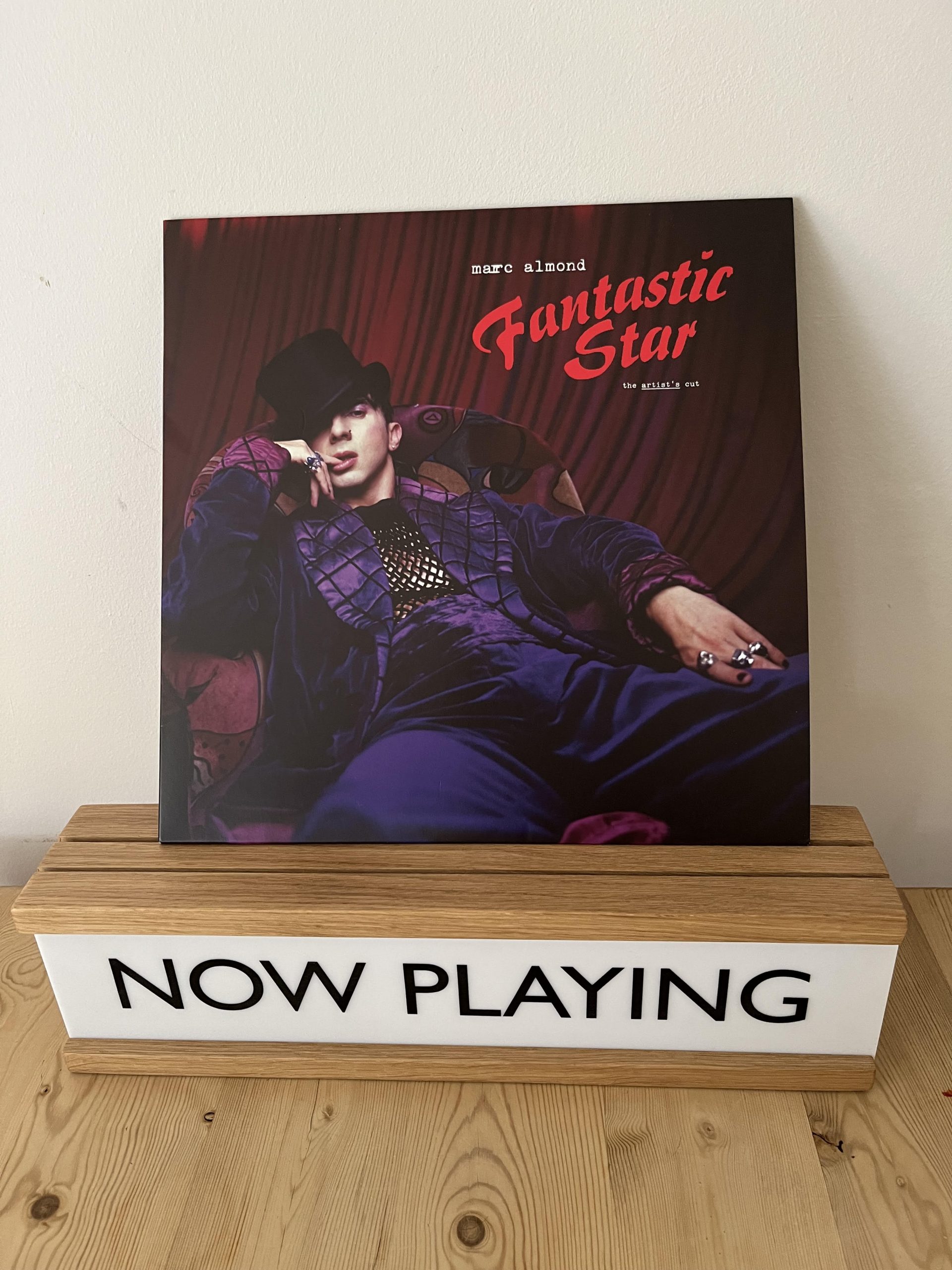
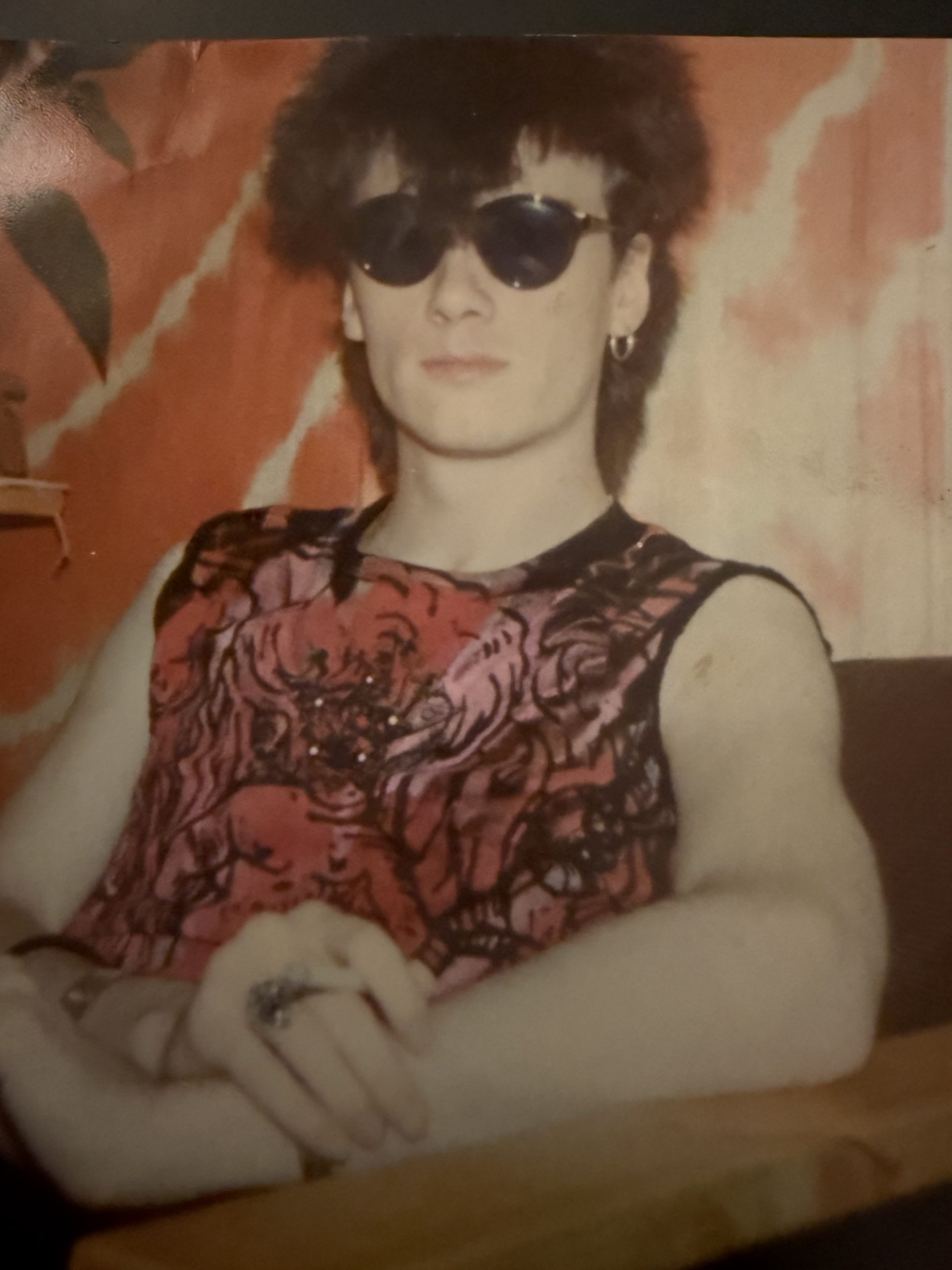

It was 1989 and there I was, a fresh faced 19-year-old, strolling through a Spanish holiday resort of an evening, wearing with pride my Marc Almond ‘Pushing Ink’ t-shirt, which of course was the merchandise of choice during the magnificent Stars We Are era.
As I strolled, a small group of lads ran past and I heard one of them shout back at me, ‘I live next door to Billy McGee!’. He had obviously observed my clothing attire and felt the need to share his connection with Billy, who of course was a long-term musician and collaborator of Marc’s, being a pivotal member of the Mambas, the Willing Sinners and La Magia, as well as wearing numerous musical and lyrical hats on the 1990 Enchanted album.
It kind of made my night. It kind of made my holiday to be honest and 37 years later, it still sticks in my memory.
Not only had someone taken notice of my ‘Stars We Are’ merch, but by goodness, they stayed next door to the one and only Billy McGee.
Being invested in all things Marc for as long as I can remember, I have always taken a keen interest in the musicians and collaborators who have worked with Marc to make the magic happen. From Dave Ball to the Mambas, the Willing Sinners to La Magia, then of course the long-time association with Neil X (amongst many others, of course), each and every musician and their partnership with Marc has intrigued me massively.
And I am sure you can only imagine my immense pride and pleasure to have the opportunity to sit down with one of Marc’s finest collaborators, to dig deep into just how the magic really was created throughout those wonderful years of the 80’s and early 90’s, which of course was such a prolific and creative period.
I present to you, Billy McGee.
Early Influences and Musical Roots
Billy, where did it all begin?
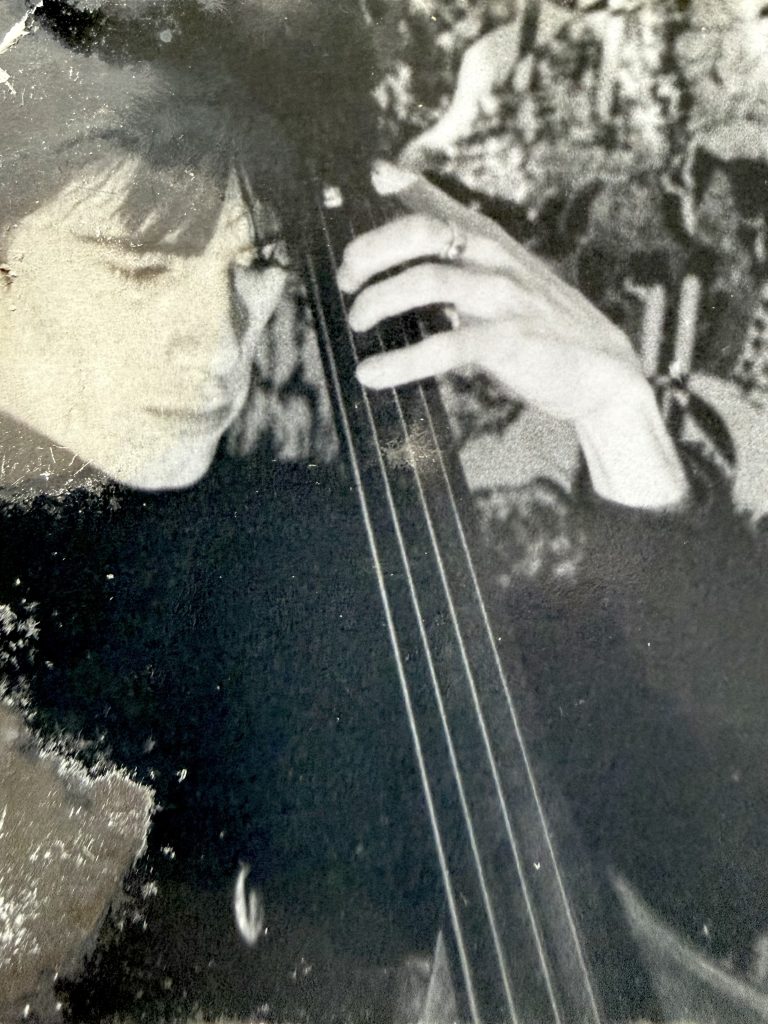
Well, I started out in a school in Leicestershire where there was this crazy lady called Avis Fawcett, who’s only just recently passed away in her 90’s. She was an astonishing woman. I remember she came into my history lesson in year 7. She asked if anybody wanted to play the violin. Without even thinking, my hand went straight up. She told me to come and see her after school. I went and she handed me what turned out to be quite a fine violin and a ‘Tune a Day’ book. It was approaching school holidays and she told me she would talk to me after holidays. Now, because she was quite a fierce lady, I thought I had better work my way through the book. It takes you from opening strings on an instrument and by the end, you are playing ‘Blue Bells of Scotland’ and everything in between. I suppose that is where it gets its name! Anyway, I went to see her on our return from school and she said ‘let’s see how you got on, dear’, because she called everyone ‘dear’. I just went to the back page and played the Bluebells, which rhythmically is a bit complicated. She was astonished! She gave me a hug and told me she didn’t expect me to work through the whole book, telling me nobody has ever done that. That was the beginning, my introduction to music.
I also learned to play the viola as well and when I was about 16, I auditioned for the Leicestershire School Symphony Orchestra, which was amazing. I was told, there was no doubt I was an excellent musician, but they were really concerned about my bow hold. My bow hold was quite bad because I had a bad accident on my arm when I was 10. I lost the use of my right arm for quite a while and as a result, I had to become left-handed. When I held the bow, I held it quite an awkward way.
I was told I may find holding the bow for a double bass a bit easier. I responded by saying I was a violinist, but I would give it a shot. Within 3 months, I was playing grad 8 music on the double bass! And the rest is history.
Your school teacher obviously had a massive influence in your introduction to music. Did you progress to study music at college?
Yes, I went to Guildhall School of Music. Whilst my musical journey started by accident, I soon knew I just had to go to music college. I didn’t care what I did there, whether it was violin, double bass, anything really. I just knew I had to study music.
Did your family support your musical journey?
Well, let me share this this memory with you. It was the summer holidays, 6 weeks of no tutor. I was practising hard in my bedroom. Mum and dad, downstairs, with 3 television channels for company. Me, upstairs, with my instrument. Mum shouting up the stairs in her strong, Irish accent (we were from an Irish immigrant background), turn that ****** thing down will you. And me shouting back down the stairs, ’it hasn’t got a volume knob on it.’ But the thing was, was by the end of the holidays, I would be in my room, look around and mum would be standing in the doorway, or dad, watching and listening and proud. One day, mum asked me if I could play ‘She Moves Through the Fair’, which is a traditional Irish folk song. It was one of her favourite songs. I cracked it!
What did your friends think about you, hoarded up in your room, playing your instrument?
Mum was very strict, and I wasn’t allowed out after a certain time. Everyone else was out in the street, playing, but not her boy. I was upstairs practising in my bedroom and it became kind of an escape, if you like. There is a funny moment when it was a summer’s night, everyone but me out playing in the street. I am in my bedroom, practicing the second violin part of Bach’s Double Violin Concerto. I am playing and playing it but keep getting it wrong but I stick with it, having a little break and then going at it again.
And then, you know, you reach that point where you think, well, I’m just going to stop for a second and then I’m going to go to the beginning and I’m going to play through it, see how it goes. And I did. I played all the way through, and I got to the very end. And then I heard this rapturous applause. And I looked out the window and all the kids on the street, they’d all stopped what they were doing. They were listening and shouting ‘you did it, you did it.’ Because they’ve been taking the **** out of me all night long. And I didn’t even know that they were listening. But they all kind of admired my tenacity and resilience, I guess.
You mention your Irish background. I am a big fan of Kevin Rowland’s music, who shares a similar background to you.
Ah, Kevin. I had an interesting interaction with him in the 90’s. He was making a comeback as a solo artist and phoned me up, with a view to me playing on his album. He called me and said he was going to send me a tape of Bridie Gallagher. Now, my mum used to listen to Bridie Gallagher all the time. Kevin tells me he wants the strings to sound like this, but can I send me some of my work so I can get the idea of your playing. I said yeah, sure and sent him stuff I had done with Nick Cave and Barry Adamson. I had also just done some work with Roddy Frame and sent him that also. Just a few tracks. Kevin then called me back a few days later. He said he has just been listening to my portfolio and I just don’t think your work is good enough, sorry. I said, ‘really’. He said yeah, and put the phone down. That was it!
But the funny thing was, I got a phone call the very next day from Bernard Butler saying, are you free to do my next album? And because I’d worked with him before, I was like, yeah, why not. It’s funny how things, you know, turn around.
I think he missed a trick because we were from the same background. We have a very similar history. I knew Bride Gallaghers work and she was played at my mum’s funeral. The music was a part of my life, I totally undstood all the arrangements. I knew exactly what he needed. I could have given it to him, but I sent him the wrong portfolio. My management told me not to send my Marc Almond portfolio, but perhaps if I had sent my work with Marc e.g. Something’s Gotten Hold of my Heart, he would probably have gone ‘oh yeah, great, you are the guy that did that’. But I didn’t.
The (Short) Beauty that was Marc and the Mambas
You attended the Guildford School of Music and Drama, during the period when Marc was just starting to surface with Dave and Soft Cell. How did you first become involved with Marc and your fellow Mambas, as you played extensively on Torment and Toreros?
Martin McCarrick and I were in the same year at Guildhall together. He was playing in the chamber orchestra, whilst I was playing in the symphony orchestra. Martin was at college one day, rehearsing and I was at home practicing. We shared a flat together and he came home and said ‘oh, I’ve just been talking to Anne Stevenson’ (she was at Guildhall too). Anne had said that Soft Cell are auditioning tonight for backing vocalists. Do you want to do it? I said, ‘do you think we should’. Martin said, come on, it will be a laugh. I said, yeah, let’s do it, let’s do it. So we went down to the studio in Shepherd’s Bush. Now,, when you’re trained to do music, you must be able to sing. Everything’s about singing. So we kind of passed with flying colours. It was me, Martin, Anne Stevenson, and Ginny Ball, but she was Ginny Hughes at the time.
Marc told us it we were great and shared a list of dates for the Art of Falling Apart promotional tour. We said, ‘wow, yeah, great, yeah, sure.’ Marc then said ‘Anne and Ginny tell me that you two (Martin and I) play the double bass and the cello’. Marc then said there is a session tomorrow night at Trident Studios with the Mambas and did we want to come along. We’re like, **** yeah. Because it’s like, you know, Trident Studios, that’s where Bowie recorded Hunky Dory. It’s where Yes recorded all their albums. Yes were the first band I ever saw live. And I was like, Jesus. So yeah, definitely. But it was starting at 10 o’clock in the evening. And went through to 6:00 in the morning. It turned out to be a 10 day session, there every night, 10pm to 6am, then going to college.
Torment and Toreros has become this kind of seminal album, hasn’t it? It was my first experience of recording, and it was incredible and I loved it. It was just amazing. But, you know, the subject was dark. Everything was very, very dark. And then when we got the album, I listened to it and I have not listened to it since. I have a copy of it somewhere, probably in my shed. Sometimes certain tracks will come into my mind, and if I do really want to play them, I will stream them but I haven’t listened to the whole album since that first time.
I loved Marc so much and still do, but the recording process back then, given our time again, it could have been better. But that is just the way it was. We would listen to it back and I would feel it could be improved. I am sure everyone, including Marc, who played on the album would agree it was all a bit chaotic. It was a dark time but a great time.
Billy, what are your memories of the Mambas ‘Duke of York’s Theatre’ gigs?
We did a mini tour of Israel with the Mambas, then I think it was afterwards we played the Duke of York’s Theatre. It was catastrophic but great fun. We were on stage and a lot of mistakes happened, but that was simply how it was. Now, I am talking here from a musician perspective, being on stage and noticing the mistakes. However, to the audience, I am sure it sounded fantastic and I know a lot of people say they love the concerts, therefore I shouldn’t really judge it. But it required a lot of rehearsal and, well, there was very, very little rehearsal.
And the thing is, it got really slated in the press. We played 3 nights in total. It was really funny because we had all these terrible reviews after the first gig. Hugh Feather said we should do what they always do in the West End Theatres and misquote the reviews. You know, if they said ‘it was a truly awful experience’, we would get rid of the word awful and simply quote ‘it was truly an experience’. We, as a band, were loving this approach and laughing so much. It was really funny. All these posters were printed and put outside the Duke’s in time for the next gigs, quoting the NME and the alike. Hugh Feather was the brains behind it. He was very funny. Hugh was the guy who did our lighting and was Marc’s best friend back in those days.
..and the Mambas look. Did you naturally look like that?
No. Well, actually, I had the spiky black hair. But for the photo session, everyone had to dress in black and red. And because we were also playing with Soft Cell. Martin McCarrick and I were given £100 each and told to go out and buy leather trousers and a leather biker jacket.
I remember for the photoshoot, the one you can see online, the guy doing my makeup would not stop putting makeup on me that day. I was saying to him, ‘I’m not sure about this’ but he just kept telling me I looked fantastic, amazing. Then, when I saw the photographs back, I was like ‘oh, jeeze’. It is the picture that is on my Discogs. No idea who put that on.
The Mambas came, conquered, and went. How did the opportunity to join The Willing Sinners come about?
I remember, I was working on my finals at college when the phone rang. I picked it up and it was Marc, saying, have you heard the news about Soft Cell splitting? I said I had and was sorry to hear. Marc then asked me if I could come into the office, as he wanted to meet with me, Annie Stephenson and Martin McCarrick. We arrived for the meeting and Marc told us he wanted to start again, with us 3 in his band, plus Steven Humphreys and Richard Riley.
And that was the beginning of The Willing Sinners!
Yes, it certainly was.
Recounting that era, I do think Marc was (and is) a great star in many ways.
It was wonderful being on stage with him, but there was one time when I wasn’t required and I went along to see him at the Palladium. From memory, it was just him, Annie Hogan and Steve Humphreys. Marc was wearing like a striped top and a sailor’s hat. It was the look at the time, around the Mother Fist era. Marc may have been doing some Jacques Brel also, my mind fails me but Martin McCarrick and I were not required. Anyway, he was also wearing these really tight drainpipe jeans and massive Doc Martin boots. His face was painted white with really black eyes. He absolutely owned the stage that night. I saw Marc at Palladium and somewhere else (sorry, I cannot recall where) and on both occasions, I was absolutely gripped. Really gripped. Such a great performer. He was incredible live and absolutely ate the stage. He never stood still for a minute. He used to make jokes, saying it was harder to hit a moving target.
He was just amazing and lyrically also. I don’t think anyone comes close to him. Perhaps Leonard Cohen, or Tom Waits came close to that sort of beautiful lyric writing. There were lyrics Marc wrote where I felt like he was writing about my life, you know, and I am sure lots of people felt the same.
Talking about the Mother Fist era, I loved the song ‘There is a Bed’. I play, technically, 4 notes on it. I remember Mary Coughlan version also, which was superb. Another song I loved and should have been a huge success was ‘I Who Never’. ‘Sat sad by a silent phone, changed my number forgot to tell the world’. What a beautiful lyric. So beautiful.
Vermin in Ermine was, of course, Marc’s first solo album. Can you share any memories from this era?
Well, to start with, we recorded it in the only digital studio in Europe, Hartmann Digital in Bavaria. It was a really mad time but fantastic. The studio was in a tiny little village called Egloffstein but it was actually quite a long way to the actual village from the studio. The nearest town was Erlangen, with the nearest city being Nuremberg. So, we would fly to Nuremberg then drive for two or three hours to get to this place in the middle of nowhere in Bavaria. When we got there it was like amazing, the first ever digital studio. We had pinball machines and a pool room, saunas, and we could all stay in the studio. And it was Mike Hedge’s first album with us and it was really good fun. It did get a little claustrophobic after a while because we were like in the middle of nowhere. I think about nine months we were out there. We occasionally went back for visits back home, but generally we were out there for that period. Some of us, I’m not going to mention any names, it wasn’t me, was calling home a lot, right? And in those days, you know, international calls cost a lot of money. The bloody record company took it out of our advance!
So, you know, yeah, we had a great time in creating Vermin in Ermine and I really thought The Boy Who Came Back was a beautiful song and had a real feel to it. Enrico Tomasso in on trumpet for that, and it was it was lovely, but you know there was a couple of TV promos and then it just died the death. I remember doing the demos for it and I think that was the song where Marc said to me, would you mind playing bass guitar? And I said, oh, okay. He then said he would buy me a bass guitar if I would play it live with him. And he did. Before that, I was doing everything on a double bass.
I recall Ruby Red, of course. The band are in the video, did you know that? Peter Kristofferson directed Ruby Red. I used to work with his band, Coil and did a lot of work with them. I was very close to Peter. He went by the name of ‘sleazy’.
I have recently been playing, on loop, a B side from this era, Anarcoma. Do you recall, Billy?
I do indeed. It would have been around 1983 or so. We were in Barcelona in an incredible comic shop, and we found the comic that had the character Anarcoma in it. We thought it was hilarious. I bought a copy, as did Marc. Not sure if Martin did.
But we were like, this is fantastic. Then the next thing I know Marc has written a song about Anarcoma. I probably still have that magazine somewhere up in the loft, you know. But yeah, that was Anarcoma. It was amazing.
Before we move away from The Willing Sinners period, do you have a favourite album?
Mother Fist. Definitely.
Did the move to La Magia feel like a natural continuation of The Willing Sinners, or a little bit different?
It felt like a complete break to be honest. I remember Richard Riley saying he felt like he wasn’t being used very much on the Mother Fist album. Even though I think he did wonderful stuff on Mother Fist, it wasn’t an album that required a lot of guitar. But what he did do, was great. Richard decided he was moving on. Martin was headhunted by the Banshees and he also left. Marc wondered how we were going to do this, with just the 3 of us. I just kept saying ‘it’s going to be fine’. I remember Annie being worried about it also and again, I reassured her, saying we will be fine. I said we have just got to change what we are doing and you know, we did. There was Annie on piano, me on bass, piano and double bass, with Steve on drums and sampler. In many ways, I think we made an even bigger sound than The Willing Sinners. I remember us playing a gig at the Apollo Theatre and it just felt like ‘wow’, we are absolutely kicking *** here. It sounded great.
We went into a rehearsal studio to start writing some songs for a new album. The first thing we wrote was Tears Run Rings.
Moving onto the Enchanted album and specifically Madame De La Luna. It is probably my favourite song from the various Marc eras.
Well, thank you. I worked pretty hard on that song. Well, I mean it was one of those songs that Marc and I worked on very closely. We wanted it to be quite ‘dreamy’, we wanted a bit of a tango with a violin solo over the top of it. We wanted flugelhorn solos. It was great. There is even a bit where I go into a waltz and stole parts of Mary Poppins, because Marc loved Mary Poppins. And you know, the lyric ‘moon, moon delirious moon, dancing a waltz’, that is from Mary Poppins and he loved it. Marc had a special relationship with the moon, as did I. I have always been obsessed with it and the idea of writing something about the moon, especially Madame de la Luna, it is such a beautiful title.
‘Gold in her veins’. Magnificent lyrics.
Any other tracks stand out for you on Enchanted?
Yes, I loved Orpheus in Red Velvet, plus the story in Widow Weeds.
The final album of your tenure was Tenement Symphony
There was one song that really stuck out for me on this album. It is Champagne. When Marc sang it, I wanted to hug him, you know. We all want a little taste of champagne. It is just so moving.
Are your students aware of your professional musical career?
Some of them are, yes. I tend not to talk too much about it. I tell them that I’ve worked in the profession and that when I’m telling them something, they should trust me and they do.
Some of them have found out stuff, but I tend not to talk about it because it’s like years, decades before they were born. So, you know, what would they be interested in?
Huge thank you to Billy for sharing his time and memories.
PS I would love to create an album by album, track by track review by Billy. Fingers crossed.